Note: At the end of this page, you can find a video proof. We have included it because there are many scammers in the market.
Over a three month period from June 28 to September 13, 2026, we took an educational gaming blog from roughly 100 pages and no measurable search visibility to 969,000 Google impressions, 9,300 clicks, and an average position of 6.9 across 368 pages that earned impressions.
The work was almost entirely content and structure. We ran keyword research across the niche, identified more than 400 viable topics, published around 200 new pages, and connected them through a deliberate internal linking structure. We did not run a link building campaign and we did not make technical infrastructure changes.
| Metric | Before | After (Jun 28 to Sep 13, 2026) |
| Pages | ~100 | ~300 |
| Indexed pages | Not tracked | 313 (articles pages only) |
| Pages earning impressions | 0 | 368 (all pages including categories, users profile etc) |
| Impressions | 0 | 969,000 |
| Clicks | 0 | 9,300 |
| Average CTR | 0% | 1% |
| Average position | No visibility | 6.9 |
The Challenge
The site covered a well defined niche with genuine and consistent search demand. Students and players search for game modes, items, codes, calculators, guides and event mechanics constantly, and much of that demand is poorly served.
The problem was coverage. About 100 pages existed, which is nowhere near enough to be treated by Google as a credible resource for the topic as a whole. A site with 100 pages competing in a niche with 400 plus real search topics is not an authority on that niche. It is a partial reference, and partial references get skipped.
There was a second problem. The existing pages were not connected in any structured way. Related topics sat next to each other without linking to each other, which meant nothing supported anything else and discovery depended entirely on Google finding each page in isolation.
Starting Point
- Roughly 100 published pages
- No meaningful impressions or clicks in Google Search Console
- No structured internal linking between related topics
- No keyword research or content plan in place
The zero baseline is the important part of this section and also the part that needs the most honesty. The property was verified before the project began and recorded no meaningful search data across the prior three months. That is a real baseline, not an artifact of a newly added
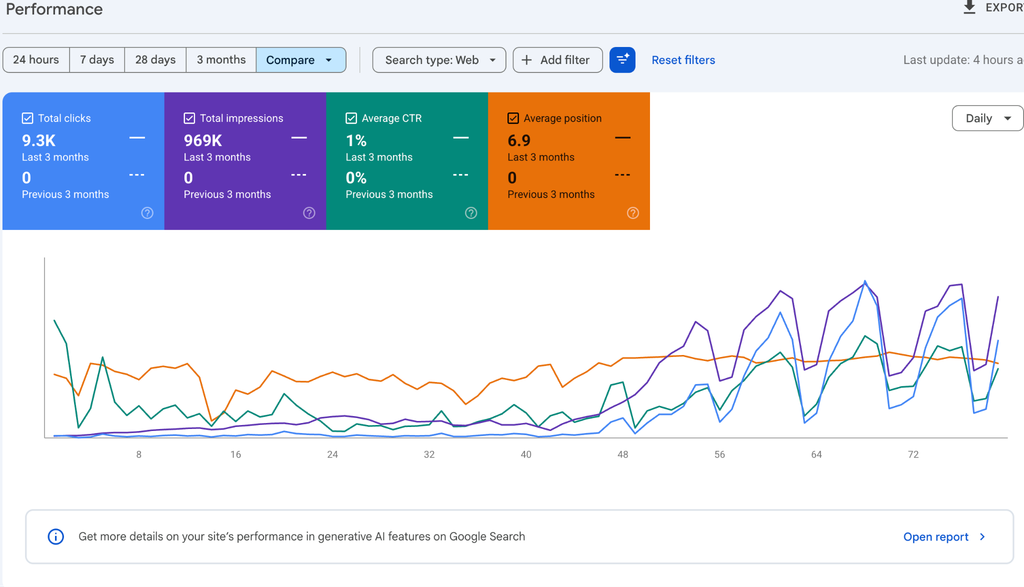
Google Search Console comparison showing the previous three month period at zero clicks and zero impressions.
Goals
We set three goals at the start:
- Expand topical coverage from partial to comprehensive within the niche
- Build an internal structure where related pages support each other rather than compete
- Reach a state where the site earns impressions across a wide range of queries rather than a handful
Note that none of these are ranking goals. We deliberately did not set a target position or a traffic number, because in a niche with this much unserved demand the constraint was coverage, not optimization.
SEO Strategy
The strategy had four parts, executed roughly in this order but with heavy overlap:
- Keyword research to map the full topic space and find what could realistically be covered
- Content expansion to go from partial coverage to comprehensive coverage
- Internal linking to connect the new pages into a structure rather than a pile
- Structured content planning to keep 200 pages consistent and non overlapping
Keyword Research
We started by mapping the entire niche rather than picking individual keywords.
The research surfaced more than 400 relevant keywords and topics. The filter we applied was not volume first. It was whether a topic could support its own page without duplicating the search intent of another page. In a niche built around items, game modes and events, that distinction matters a lot. Three items in the same category can each justify a page. Three phrasings of the same question cannot.
Most of what we found had low competition. The pages that competed for these terms were thin, outdated, or scattered across forums and video descriptions. That is why ranking happened quickly once pages were indexed, and it is the single biggest reason this timeline was possible. In a competitive commercial niche the same work would take considerably longer.
We then grouped the keyword set into clusters, so that related topics would sit together and link to each other rather than being published in isolation.
Topical Coverage
The goal of the content expansion was coverage of a subject area, not a volume of articles.
We mapped the niche into distinct content types and built out each one:
- Individual games and game modes
- Items and collectibles
- Packs and bundles
- Calculators and tools
- Events and limited time content
- Guides and how to content
- Feature and mechanics explainers
- Reference and index pages
Publishing 200 random articles would have produced 200 orphaned pages. Publishing 200 pages that together cover every part of a defined subject produces something Google can recognize as a resource for that subject. The results section shows why that distinction matters: the strongest signal in this dataset is not any single page, it is that 368 pages earn impressions at an average position of 6.9.
Content Expansion
We published approximately 200 new pages over the project period, taking the site from around 100 pages to around 300.
Search Console now reports 313 indexed pages, and 368 pages have earned at least some impressions. The gap between those numbers reflects URL variations and pages that have since been consolidated.

Google Search Console indexing report showing 313 indexed pages.
Internal Linking Strategy
Internal linking was the part of this project that did the most structural work, and it is the part that gets skipped most often on wiki style sites.
The approach was hub and spoke, applied at multiple levels:
- Broad category pages linked down to individual game, item and event pages
- Individual pages linked laterally to related items in the same category
- Guides linked to the specific mechanics, items and modes they referenced
- Reference and index pages tied whole clusters together
The intent was twofold. For users, it meant that landing on any page in a cluster made the rest of the cluster reachable in one click. For crawlers, it meant every new page had multiple internal paths pointing at it from the moment it went live, instead of depending on a sitemap entry alone.
We should be precise about what the data can and cannot prove here. We did not run a controlled test, so we cannot isolate internal linking as a cause of any specific ranking. What we can say is that pages were discovered and indexed quickly, and that impressions are spread across 368 pages rather than concentrated in the few pages that existed before, which is the pattern you would expect from a well connected structure.
How We Structured the Content
With 200 pages to produce, consistency was a bigger risk than quality on any individual page. We used a repeatable structure per content type: a consistent heading pattern, a consistent set of facts covered, and a consistent place for internal links to related pages.
We used AI tools during planning to organize the keyword set, group topics into clusters, and map which pages should link to which. To be direct about this, since it is a claim a lot of case studies overstate: AI helped us manage the scale of the planning. It did not produce the rankings. The rankings came from covering real search demand in a niche where the existing results were weak, and from structuring the site so those pages reinforced each other.
Results
All figures below cover June 28 to September 13, 2026.
| Metric | Result |
| Total impressions | 969,000 |
| Total clicks | 9,300 |
| Average CTR | 1% |
| Average position | 6.9 |
| Indexed pages | 313 |
| Pages earning impressions | 368 |
The average position of 6.9 is the number worth paying attention to. That figure is spread across 368 pages, not concentrated in a handful, and the top performing pages sit between position 6.0 and 8.6. A site that puts hundreds of pages onto the first page of results for their target queries within a quarter has established the kind of coverage that was the actual objective.
Top Performing Pages
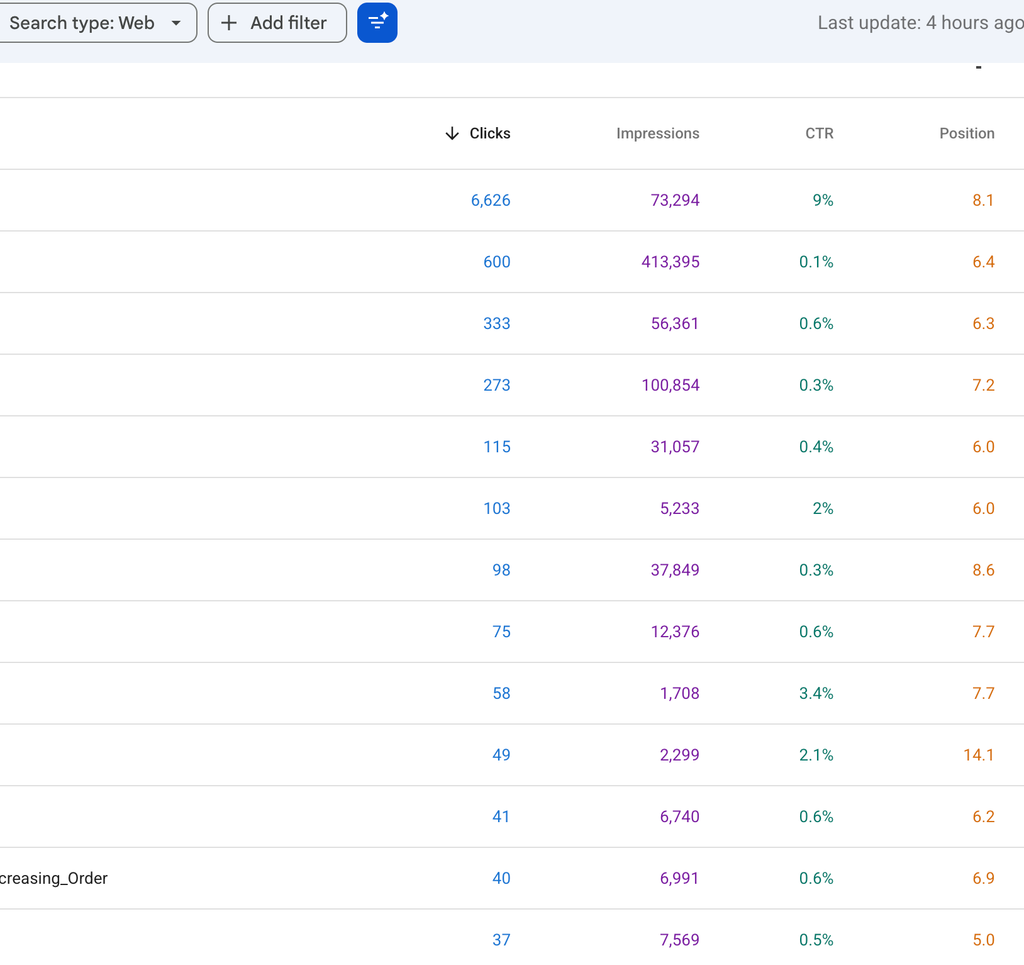
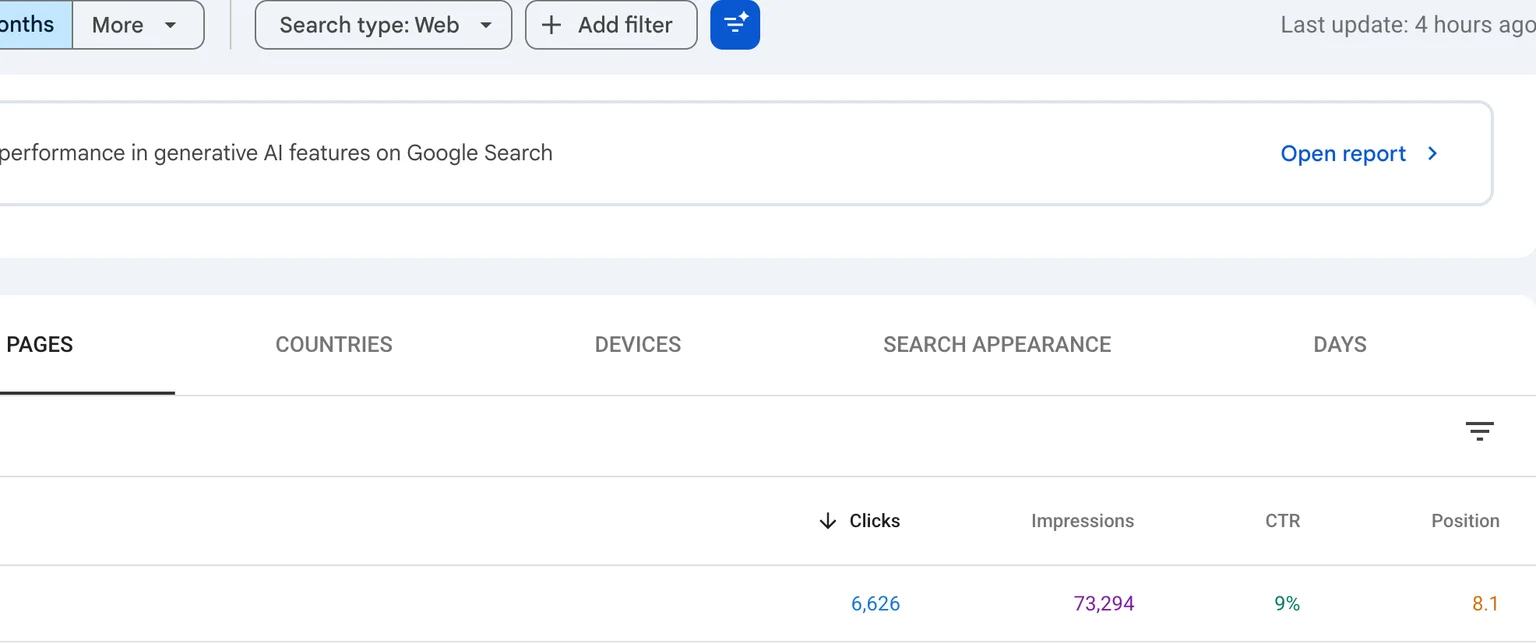
| Page | Clicks | Impressions | CTR | Avg. position |
| Bot / tool page | 6,626 | 73,294 | 9% | 8.1 |
| Codes hub page | 600 | 413,395 | 0.1% | 6.4 |
| Game mode page (fishing) | 333 | 56,361 | 0.6% | 6.3 |
| Calculator page | 273 | 100,854 | 0.3% | 7.2 |
| Item category page (mysticals) | 115 | 31,057 | 0.4% | 6.0 |
| Pack page | 103 | 5,233 | 2% | 6.0 |
| Item category page | 98 | 37,849 | 0.3% | 8.6 |
| Event page | 75 | 12,376 | 0.6% | 7.7 |
| Game mode page | 58 | 1,708 | 3.4% | 7.7 |
| Main page | 49 | 2,299 | 2.1% | 14.1 |
Two patterns stand out.
Clicks are heavily concentrated. The top page accounts for roughly 71% of all clicks. The top ten pages together account for about 90% of clicks and 76% of impressions. The long tail of 350 plus other pages contributes the remaining 10% of clicks.
Impressions and clicks come from different places. The codes hub page earns 413,395 impressions and 600 clicks. The calculator page earns 100,854 impressions and 273 clicks. Meanwhile the pack page earns 5,233 impressions and 103 clicks at a 2% CTR. The pages with the most impressions are not the pages doing the most work.
Search Visibility Growth
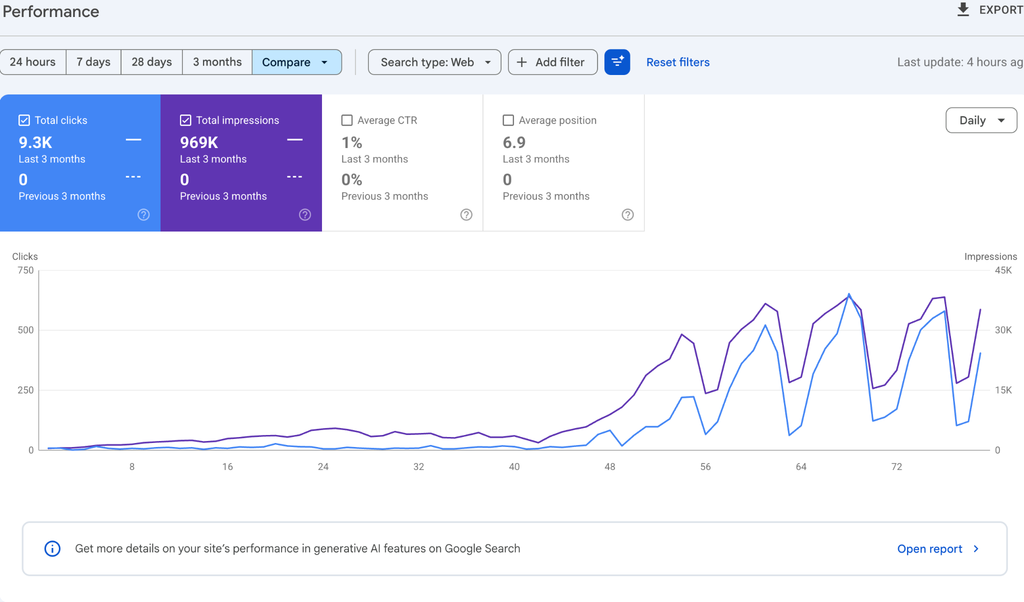
The growth curve is not linear, and the shape of it is the most instructive part of the data.
Through July, impressions and clicks stayed close to flat even though pages were being published. Movement began around August 16. From late August onward, both metrics climbed sharply, with impressions and clicks rising together.
This is a compounding pattern, not an instant one. Pages published in early July did not perform in early July. They performed six to eight weeks later, once enough surrounding content existed for the cluster to be treated as a body of work rather than a set of individual pages. Anyone running a similar project should expect a flat stretch before anything moves, and should not change strategy during it.
Growth curve showing a flat July followed by acceleration from mid August onward.
The query data supports the same reading. Impressions spread across a wide set of related queries within the niche, including long form question queries, which is the signal you look for when assessing whether topical coverage has actually registered.
Backlinks
We reached out to people and websites in similar niches and offered to audit their websites for useful SEO insights. We also offered to write relevant guest posts that could provide value to their audience. After building the relationship and providing something useful, we asked if they would consider linking back to our website where it made sense. Along with direct outreach, we also used our existing network and connections. We contacted friends and people we already knew in the industry and asked if they could provide a relevant backlink from their websites.
What We Learned
Impressions are a weak success metric on their own. Roughly 28% of all impressions in this project came from three query clusters that converted at close to zero. Queries like a bare product name plus “code” or “calculator” are navigational or tool seeking. People searching them want a live result, not an article explaining the concept. You can rank at position 5.5 for those queries indefinitely and never earn meaningful clicks. Ranking is not the same as matching intent.
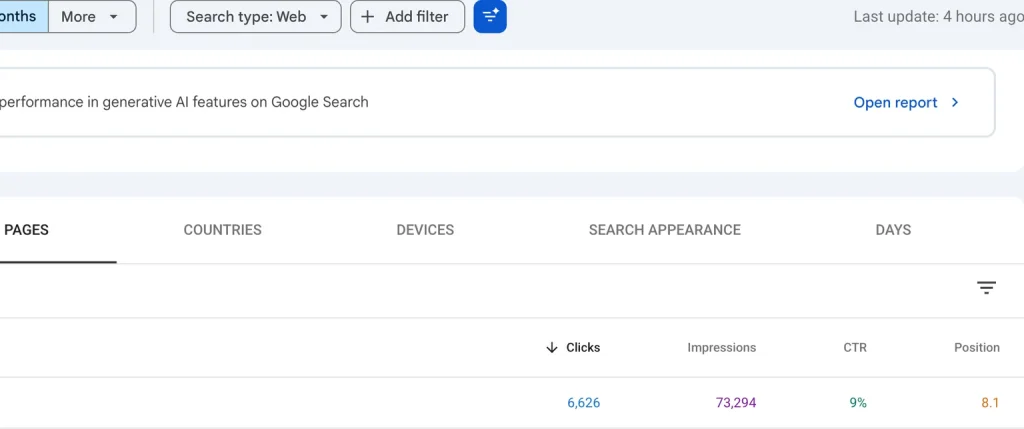
Intent match, not position, drives CTR. The evidence for this is in our own data. The best converting pages, at 9%, 3.4% and 2% CTR, do not have the best average positions. They have the best intent match. The page that ranks at 8.1 out-converts the page that ranks at 6.4 by a factor of ninety. If we had chased position alone we would have called this project a success and delivered very little.
Coverage compounds, and it compounds late. Nothing meaningful happened for the first six weeks. If the strategy had been judged at the four week mark it would have looked like a failure.
Low competition is a real strategic advantage and should be stated as such. These topics ranked quickly because the existing results were weak. That is not a reason to discount the result, it is a reason to look for niches in that condition. The same execution against strong competition would have produced a different timeline.
Key Takeaways
- Treat a niche as a map to cover, not a list of keywords to chase
- Publish into clusters, never in isolation
- Link internally from the moment a page goes live, not as a later cleanup task
- Judge search visibility by which queries convert, not by impression volume
- Expect a flat period before compounding starts, and plan for it rather than reacting to it
- Be specific about what the platform contributed and what the work contribute
Conclusion
In three months, this site went from around 100 pages with no search visibility to 313 indexed pages, 368 pages earning impressions, 969,000 impressions, 9,300 clicks, and an average position of 6.9.
The work was not complicated. It was keyword research, roughly 200 new pages, a deliberate internal linking structure, and consistent publishing. The reason it worked is that the niche had real unserved demand and the site went from covering part of it to covering most of it.
The most useful result is not the impression count. It is that hundreds of pages now sit on the first page of results for their target queries, which is what a site needs before any of the more interesting optimization work becomes worth doing.
Want to know if your site has the same gap?
Most sites in a well defined niche are covering a fraction of the search demand available to them, and most do not know which fraction. We run a coverage and internal linking audit that maps what you rank for, what you could rank for, and what is structurally blocking you.