National SEO agency
National SEO services for businesses competing across the whole country
Built on topical authority, search intent coverage, site architecture, digital PR and brand demand.
When location stops being a ranking factor, nobody is closer than anyone else. What decides it is whether your site covers the subject more completely and more credibly than the sites already there. That is the whole job, and it is a slower, deeper one than local.
- Coverage mapped against every competitor
- Written by people, not generated in bulk
- Reported on revenue, not impressions
- Month to month, no lock in
The short version
What national SEO actually means
National SEO is the work of competing for searches across an entire country, where the person searching could be anywhere and proximity gives nobody an advantage. Remove distance from the equation and two things are left deciding the result: how well the page answers the question, and how much reason there is to trust the site it sits on.
That changes the shape of the work. A local campaign can win on a well kept business profile and a handful of good pages. A national one cannot. You are up against every other company in the country selling the same thing, including several who have been publishing on the subject for a decade. Beating them takes depth, structure and time, in that order.
It also changes what counts as progress. Early on, the thing to watch is not position one. It is whether the number of queries you appear for at all is climbing, and whether the pages earning those impressions are the ones that can convert. Rankings follow coverage. They rarely arrive before it.
The core idea
Topical authority is what national SEO is really buying
Search engines do not just score a page. They form a view of whether a site is a credible place to learn about a subject. One good article does not create that. A connected set of pages covering the whole subject does.
The structure that produces it is not complicated. One substantial page owns the main commercial term. Around it sit cluster pages, each taking one real sub question in depth. Every cluster links up to the pillar and across to its siblings, so the whole group reads as one body of work rather than scattered posts.
Done properly this does three things at once. It gives you a page for every way someone might phrase the problem. It concentrates internal links on the page that actually sells. And it makes the site legible, so a search engine can tell what you are the authority on without guessing.
The failure mode is publishing volume without structure. Forty unconnected articles is not authority. It is forty pages competing with each other for the same handful of terms, which is measurably worse than having four.
The modern results page
Position one is no longer the only thing worth having
A national results page is crowded now. AI summaries, people also ask, featured snippets and shopping panels sit above the first blue link, and a large share of searches end without anyone clicking through at all.
This is why a national campaign cannot be measured on ten tracked keywords. The same page can be invisible at position four and highly visible as the source behind an AI answer, and neither shows up in a rank tracker.
What earns those placements is fairly consistent. Give a direct answer in the first two sentences under a heading that matches the question. Use clean lists and tables where the content genuinely is a list or a table. Mark the page up so a machine can parse it. And be a source worth citing, because AI answers lean heavily on sites the rest of the web already treats as reliable.
None of that is a trick, which is the point. The pages that win these surfaces are the ones written to be genuinely useful to a person who is in a hurry.
How a campaign is built
Four layers, and they have to go in this order
Skip a layer and the ones above it underperform. This is the single most common reason a national campaign spends a year producing content that never ranks.
Technical foundation
Crawlable, indexable, fast, one canonical version of everything. Unglamorous, and a page that never gets indexed cannot rank however good it is.
Site architecture
A structure where every commercial page is close to the homepage, related pages support each other, and no two URLs are chasing the same query.
Content coverage
One page per real question, written to actually answer it. This is where most of the budget and nearly all of the time goes.
Authority
Mentions, citations and coverage from places your industry already reads. The slowest layer, the hardest to fake, and the one competitors cannot copy in a quarter.
Where the time goes
What a national campaign actually spends its hours on
Roughly how a typical month breaks down once the technical foundation is sound. The split shifts with what the audit finds, but the shape holds.
Content and coverage50%
Research, briefs, writing, rewriting
Mapping what you are missing against everyone ranking for it, then closing the gaps one page at a time. Existing pages that underperform get rewritten before new ones get commissioned.
Authority and PR30%
Earning the mentions that count
Data, commentary and resources worth citing, placed where your industry already reads. Slow, compounding, and the part competitors find hardest to replicate.
Technical and structure20%
Keeping the foundation sound
Internal linking, crawl health, schema, page speed and the architecture decisions that make everything above them work harder.
What is included
The work in a national SEO campaign
Sequenced by what the audit finds. A site with clean architecture and thin content gets a very different first month to one with the opposite problem.
Topic and cluster mapping
Everything your market searches, grouped into pillars and clusters, then checked against who currently ranks. You get the map before anyone writes a word.
Competitor coverage gap analysis
Every term your rivals rank for that you have no page at all for, sorted by commercial value rather than by volume, so the list is a work plan and not a spreadsheet.
Site architecture and internal linking
Depth, hub pages, breadcrumb logic and a linking pattern that pushes authority toward the pages that make money instead of pooling it on the homepage.
Commercial page rewrites
Your service and product pages rebuilt to answer what the buyer wanted, with the proof, the pricing signals and the objections handled on the page rather than after a call.
Content programme
Briefs, drafts, edits and a publishing cadence you can actually sustain. Written by people who read the sources, because a national market can tell the difference.
Technical SEO
Crawl budget, indexation, Core Web Vitals, canonicals, rendering and structured data. The layer everything else is standing on.
Digital PR and link earning
Original data, expert commentary and resources pitched to publications your market already reads. No networks, no paid placements dressed up as editorial.
SERP feature and AI visibility
Answer formatting, schema and entity signals so your pages can be pulled into snippets, people also ask and the AI summaries that now sit above everything.
Measurement that survives scrutiny
Brand separated from non brand, organic separated from paid, and a monthly read on which clusters gained, which stalled and what it was worth.
Is it right for you
National SEO is a long game, and it does not suit everyone
It is expensive to start and cheap to keep. If the maths only works with results inside one quarter, this is the wrong channel and we will say so.
This fits you if
- Your customers can be anywhere in the country and location is irrelevant
- Your average deal or order value justifies a twelve month payback
- You can publish and ship changes without a three month approval chain
- Someone internally can review content for accuracy, because we will not fake expertise
- You want a channel that keeps paying after you stop spending on it
Something else fits you better if
- You serve one city or a travel radius, which is local SEO
- You sell a large catalogue online, which is ecommerce SEO
- You need pipeline this quarter, in which case paid search should come first
- Your category is so new that nobody is searching for it yet
- Your budget only covers three months, which is not long enough to learn anything
Selling into more than one country changes the job again, because domain structure and hreflang start deciding whether your market versions help or cannibalise each other. That is international SEO, and it sits on top of everything on this page rather than replacing it.
Your first 90 days
How we open a national campaign
Map the territory, fix what blocks it, then start closing gaps in the order that pays back fastest.
Weeks 1 to 3
Map the market
Full topic map, competitor coverage comparison and a technical crawl. You end with a written picture of exactly where you stand and what the gap is worth.
Weeks 4 to 6
Clear the blockers
Indexation problems, cannibalised pages, broken internal linking and anything stopping what you already have from performing.
Month 2
Fix what exists
Rewriting the commercial pages and the near miss content first, because improving a page that already ranks on page two beats writing a new one.
Month 3
Build the first cluster
One complete pillar and cluster set published and interlinked, so we can see how your site responds before committing the rest of the year to a pattern.
Month 4 onward
Scale and earn
More clusters on the proven pattern, digital PR running alongside, and reporting on non brand revenue by topic rather than on a keyword list.
Evidence
What compounding coverage looks like
These are Search Console exports from client campaigns. The shape is the thing to look at: flat for the first stretch while coverage is being built, then a climb that keeps going.
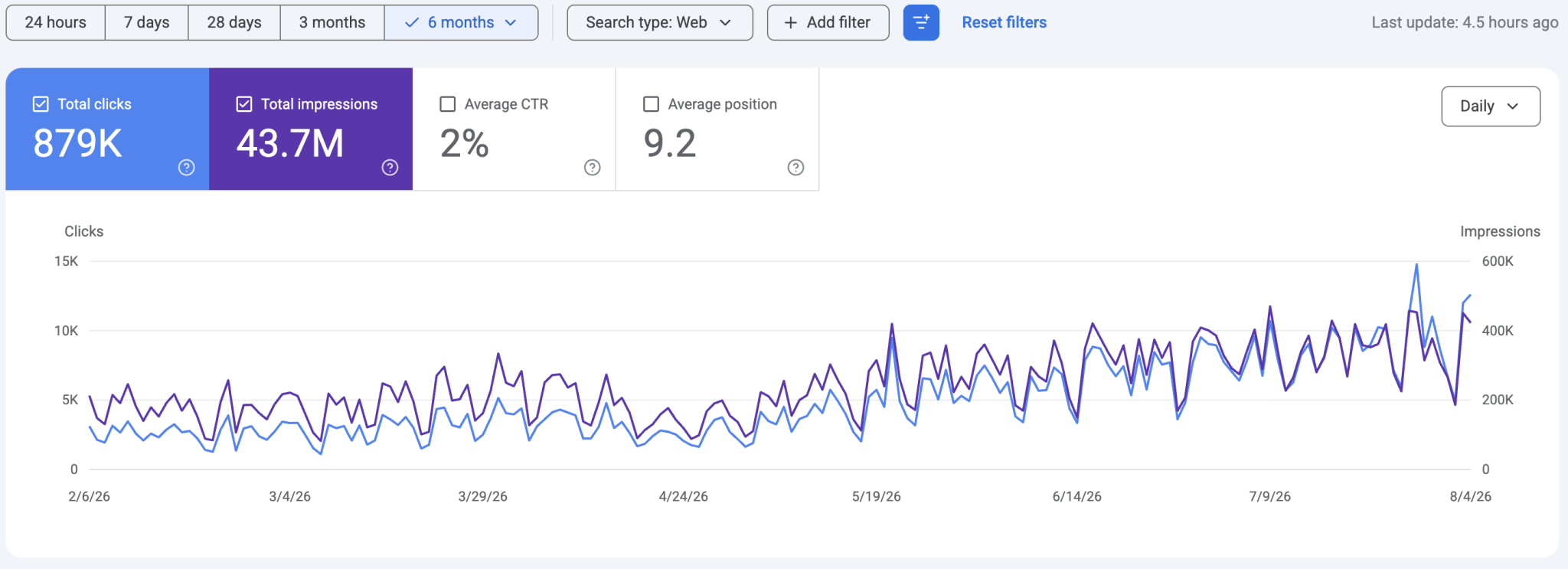
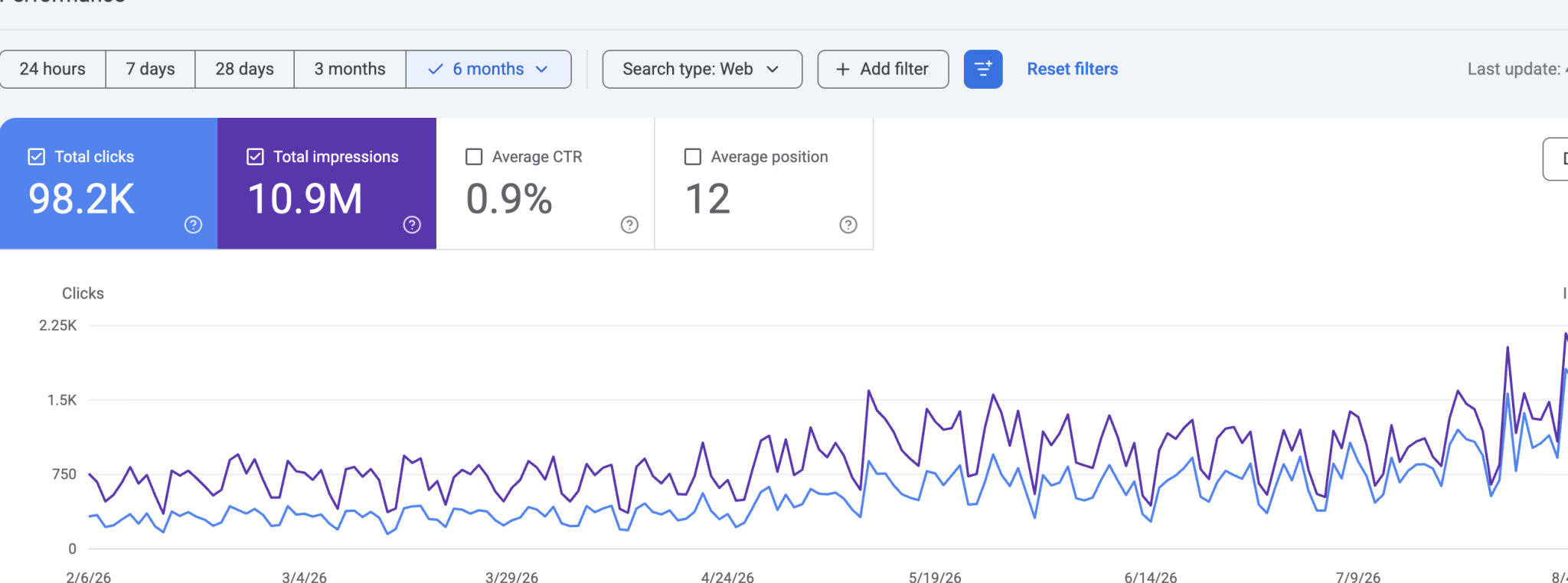
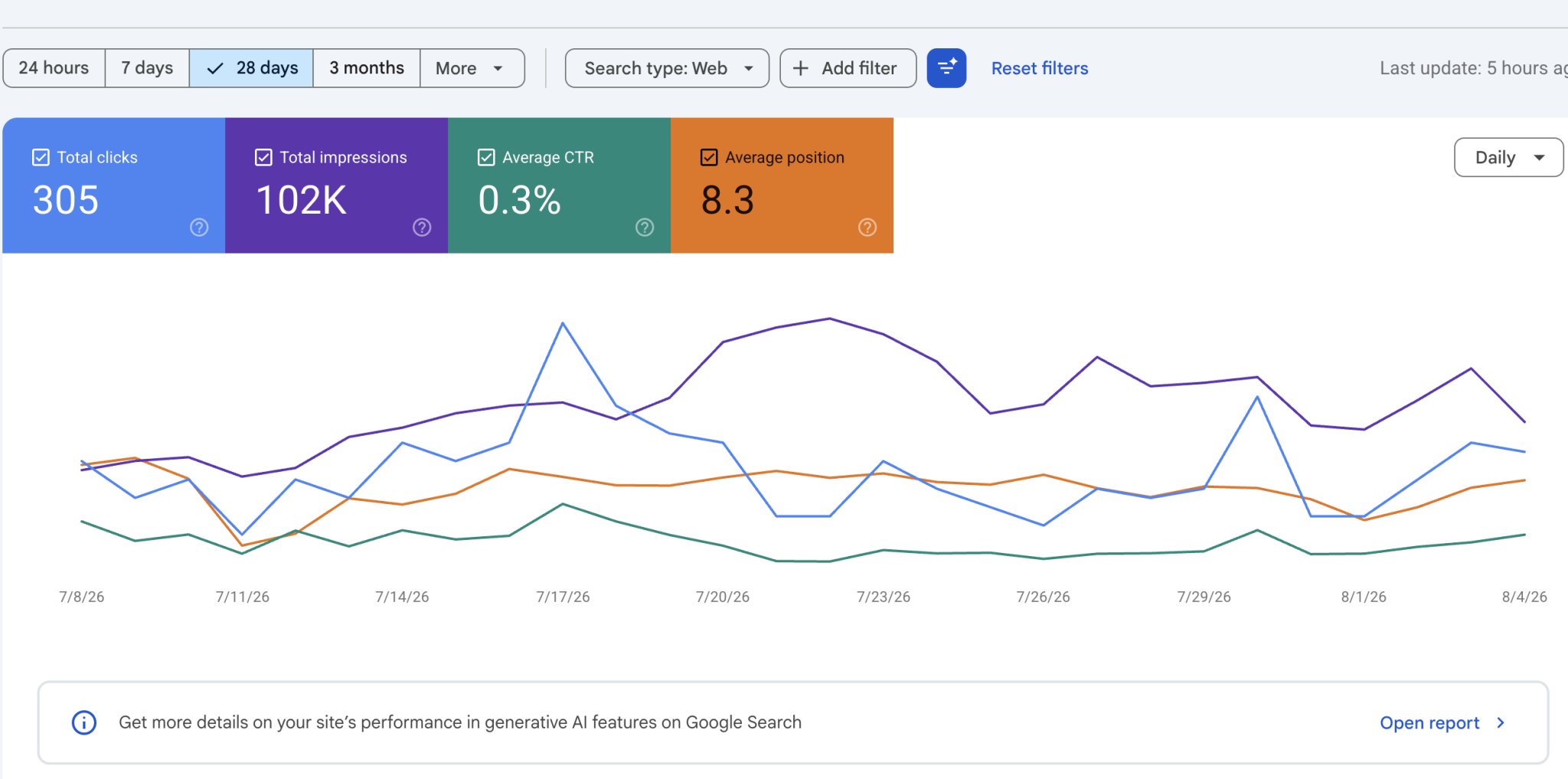
Worked examples with the full story behind them are in the luxury watch retailer and footwear store case studies. We only publish figures we can substantiate and explain.
Cost
What national SEO costs
Driven by how competitive your subject is, how much usable content you already have, and how fast you want coverage to widen. A crowded national market is the most expensive thing in search, and pretending otherwise helps nobody.
- How competitive your subject is
- How much usable content you already have
- How fast you want coverage to widen
Our entry plan starts lower, but it is built for a single market rather than a national programme, and we would rather tell you that now than under-resource the work. If you want the background first, read our plain guide to SEO for business owners.
Monthly retainers
Scoped after the topic map and crawl. Both are free and yours whatever you decide.
$1,999per month, typical national starting point
- Free topic map and technical crawl first
- Month to month, no lock in
- Reported on non brand revenue by topic
Where we stand
How we will not try to shortcut this
National competition makes shortcuts tempting, because the gap between you and an established competitor looks impossible to close honestly. It is not, it is just slow. These are the things we refuse.
- Publish AI written articles at volume and call it a content programme
- Buy guest posts on sites that exist only to sell guest posts
- Attribute expert quotes to people who never said them
- Chase a keyword list your sales team cannot sell against
- Report brand traffic as if the campaign earned it
- Promise a timeline we have no evidence for to close the deal
Questions
National SEO questions we get asked
What is national SEO?
National SEO is optimising a website to rank for searches across an entire country rather than in one area. Because the searcher could be anywhere, proximity gives nobody an advantage, so results are decided almost entirely by how well the content answers the query and how credible the site is on that subject.
How is national SEO different from local SEO?
Local competes inside a radius, so your business profile, reviews and area pages carry most of the weight, and results can move in weeks. National removes the radius, which means you are competing with every company in the country. The levers become depth of coverage, site structure and earned authority, and the timeline stretches from weeks to quarters.
How long does national SEO take before it pays for itself?
Plan for twelve months to break even and longer in a crowded subject. You should see leading indicators much sooner: impressions and the number of distinct queries you appear for usually start moving inside two to three months, well before revenue does. If those are flat at month four, something is wrong and we should be talking about it.
How many pages does a national SEO campaign need?
Fewer than most agencies will tell you. The number comes out of the topic map, not out of a package. Some subjects are covered properly in forty pages, some need three hundred. What matters is that every page has a distinct question to answer. Adding pages past that point splits your own signals and makes things worse.
Can we use AI to write the content?
For research, outlining and first drafts, yes, and we do. For publishing unedited, no. In a national market you are competing against people with genuine operating experience, and a generated article reads like a summary of everything already ranking, which is exactly what has no reason to outrank it. The value is in what your team knows that is not on the web yet.
Do we still need links for national SEO?
Yes, and at national level they matter more than anywhere else, because everyone competing has decent content. The difference is where they come from. One mention in a publication your industry reads is worth more than a hundred placements on sites that exist to sell placements, and carries none of the risk.
What should we be watching month to month?
Non brand impressions, the count of distinct queries you appear for, average position by cluster rather than by keyword, and assisted conversions from organic. A tracked keyword list is the least informative number in the report, which is why it is not the one we lead with.
What happens to the work if we stop?
It stays yours and it keeps working for a while. Published pages do not disappear, the internal linking stays in place, and earned coverage does not get taken back. What stops is the compounding, and competitors who keep publishing will eventually pass you. There is no contract to exit and nothing of yours sits on our systems.
See exactly where your coverage stops and theirs continues
Send us your website and the two or three competitors you keep losing to. We will map what they rank for that you have no page at all for, and show you what closing that gap is worth. Free, and the map is yours whatever you decide.
Get your free coverage mapMonth to month, no lock in, and everything we build stays yours.