This year.
We’ve worked with an electronics manufacturer, a marine equipment company and a taxi startup.
Different industries with different budgets and also a different intent.
But one thing was common for most of them: same mistakes.
Almost every small business owner I talk to thinks SEO is broken, slow, or a scam. It usually isn’t. What’s actually happening is that they’re making one of seven mistakes below, and no amount of “SEO magic” fixes a mistake you don’t know you’re making.
Here’s the pattern I’ve noticed after doing this for a while: the businesses that struggle with SEO almost never have a keyword problem.
They have a discipline problem. They do the exciting parts, like launching a new page or running a promotion, and skip the boring parts, like replying to reviews or linking pages together, that actually make the exciting parts pay off.
Here’s what I keep seeing, and exactly what to do instead.
Table of Contents
1. Treating SEO Like a One-Time Task
A lot of owners think SEO is something you do once. Set up the site, write ten pages, done.
It’s not a task. It’s a habit.
I cold called a restaurant in Kathmandu with a 3.7 rating and over 400 Google reviews. Hundreds of real customers had already told Google this business exists and people like it. Nobody had touched the Google Business Profile in years. No fresh photos, no posts, no replies to reviews, not even updated hours around holidays.
That’s not a small mistake. That’s leaving free visibility on the table every single day.
Google rewards profiles that stay active. A profile that hasn’t been touched in a year signals the same thing to Google that it signals to a customer: nobody’s home.
A simple habit fixes this:
- Reply to every review within 48 hours, good or bad
- Post an update or offer every two weeks
- Add new photos monthly, not just the ones from opening day
- Keep hours accurate around holidays and events
If you’re not actively managing your listing, your site, and your content, you’re not doing SEO. You’re just hoping.
There’s a reason this matters more for local businesses than almost anything else. Google’s local rankings run on three factors: relevance, distance, and prominence. You can’t move your restaurant closer to every customer, and relevance only goes so far once your category is set. Prominence is the one lever you can actually pull every week, and it comes directly from reviews, activity, and how complete your profile looks compared to the restaurant two blocks away.
2. Chasing Keywords Instead of Answering the Question
People obsess over keyword volume. “This keyword gets 10,000 searches a month, we need a page for it.”
Cool. Does your page actually answer what the person searching that keyword wants to know?

I’ve seen sites with over 200 pages sitting in “Crawled, currently not indexed” in Google Search Console. That status means Google looked at the page and decided it wasn’t worth adding to the index. Not because of a technical error. Because the content wasn’t useful enough to bother with.
Every keyword sits behind a real question. Someone typing “best CRM for small teams” wants a comparison. Someone typing “how does a CRM work” wants an explanation.
Someone typing “CRM pricing” wants numbers. Write the wrong type of page for the wrong type of question, and it doesn’t matter how well optimized your title tag is.
Volume doesn’t get you ranked. Relevance does.
Before you write a page, ask what the reader actually wants to accomplish, and whether your page genuinely helps them do it in the first hundred words.
I go deeper into fixing this exact problem in how to fix “Crawled, currently not indexed”.
3. Publishing Pages That Nobody Links To
You write a great article. You hit publish. And then it just sits there, disconnected from the rest of your site.
Google finds pages by following links. If your homepage and your top pages never mention a page, Google assumes it’s not important. Neither do your readers.
This is one of the cheapest wins in SEO and one of the most ignored. A new page with zero internal links is basically an island. It might get indexed eventually, but it won’t rank for anything competitive because nothing is telling Google, or your readers, that it matters.
Here’s a workflow that actually works:
- Open Search Console and find your five best performing pages
- Read your new article and find one honest, relevant place to mention it on each of those five pages
- Link using descriptive text, not “click here” or “read more”
- Repeat every time you publish something new
Every time you publish something new, go back and link to it from two or three older pages that already rank well. Think of it like this: your homepage and your best pages have built up trust with Google over time. A link from one of those pages passes a small amount of that trust to the new page. Without it, the new page has to earn everything from scratch, which takes months longer than it needs to.
I wrote a full breakdown of how to do this properly in internal linking strategies.
4. Ignoring Site Speed Until It’s a Problem
Nobody thinks about site speed until their traffic stalls.
I worked with an electronics manufacturer whose site had solid content but was slow enough to hurt both rankings and conversions. We made speed a priority in week one, not month six, because a slow site punishes you twice: once in search rankings, and once when a visitor gets frustrated and leaves before the page even loads.
On most small business WordPress sites, speed problems come from the same handful of places:
- Uncompressed images straight from a phone camera
- Too many plugins doing overlapping jobs
- Cheap shared hosting that slows down under any real traffic
- No caching set up at all
None of these are hard to fix. They’re just easy to ignore, because a slow site still technically works. It just quietly loses you rankings and customers at the same time.
Speed isn’t a “nice to have” add-on you get to later. It’s part of the foundation. Fix it early or you’ll be fixing it later anyway, except with more pages to go back and optimize.
5. Sounding Exactly Like Every Competitor
Here’s a mistake that has nothing to do with technical SEO and everything to do with content.
I worked with a marine equipment company that had incredibly specific, technical products: different pontoon sizes, different spud lengths, different load capacities for different jobs. Their old homepage said things like “we provide quality marine solutions for all your needs.”
That sentence could describe literally any company in their industry. It tells Google nothing, and it tells the reader nothing.
The moment we replaced vague claims with actual specifics, real dimensions, real capacities, real use cases, the content became something only that company could have written. That’s what earns rankings and trust at the same time. Google’s systems are built to reward pages that show real experience and expertise, and generic copy is the fastest way to signal you have neither.
Ask yourself one question about your own homepage: if your closest competitor copied and pasted it word for word, would it still make sense for their business? If the answer is yes, you don’t have content. You have filler.
6. Trying to Outrank Giants With the Same Strategy They Use
A small business going after the exact same broad keywords as a massive competitor is picking a fight it can’t win.
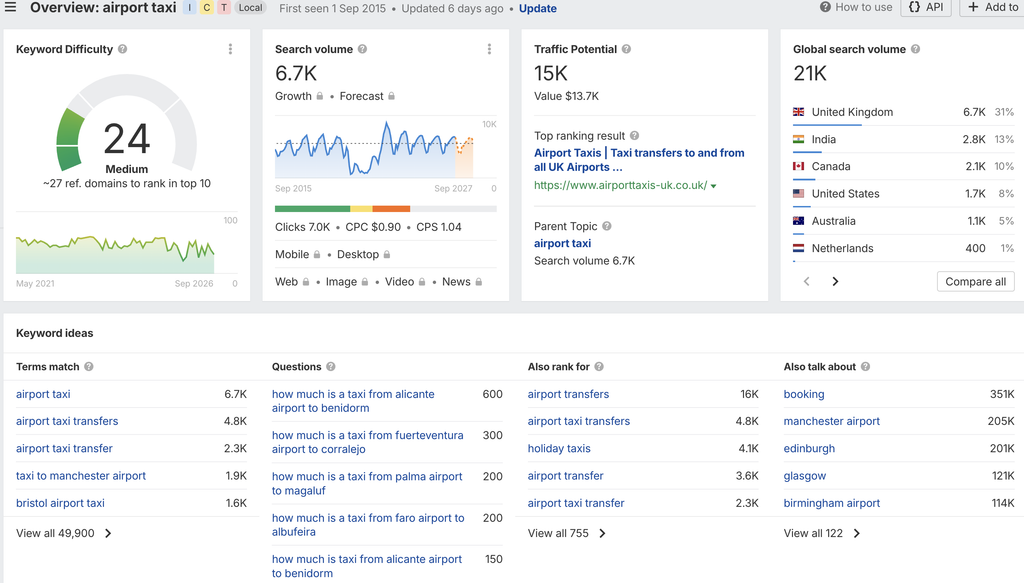
I worked with a taxi transfer startup competing against Uber’s airport pages and an established national player. Going after “airport taxi” head-on wasn’t realistic with a four-person team and a brand new domain.
The fix wasn’t to work harder on the same keywords. It was to go narrower: specific routes, specific airports, specific situations the bigger players don’t bother targeting closely. Uber and the national competitor were optimized for broad, generic searches. Almost nobody had built a dedicated page for the exact route or exact airport terminal someone was searching for.
Big competitors often win on broad terms and completely ignore the long tail. That’s exactly where a small business can actually compete and win, because you’re not fighting for the same ten spots anymore. You’re building pages nobody else bothered to build.
There’s a cost side to this too. Ranking for “airport taxi” against Uber is expensive and slow, if it’s even possible. Ranking for a dozen specific route and terminal pages costs a fraction of that effort per page, and each one only needs to beat local competitors, not global ones.
Small budgets go a lot further when they’re not spent trying to out-muscle companies with a thousand times the resources.
If you want a longer look at how much this kind of strategy typically costs to execute properly, I broke it down in what SEO actually costs per month.
7. Expecting Results in 30 Days
This last one isn’t a technical mistake. It’s an expectations mistake, and it kills more small business SEO efforts than any algorithm update ever has.
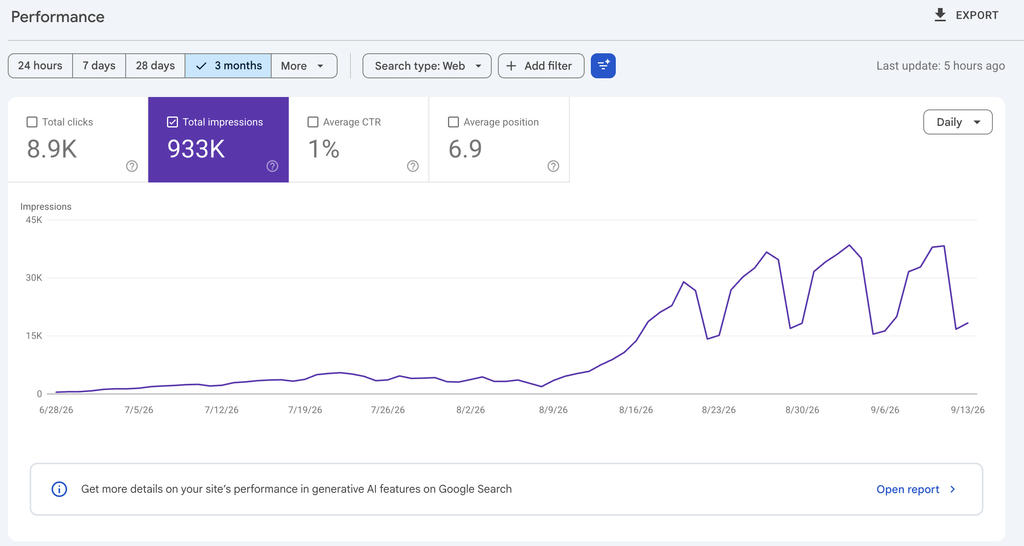
Owners see a competitor ranking well and assume it happened fast. It almost never did. SEO is closer to compound interest than a light switch. The pages you publish today build authority slowly, and that authority compounds with every additional page, link, and month the site stays active.
.
A month with flat traffic isn’t proof that SEO doesn’t work. It’s usually proof that you’re still early. The businesses that quit at month two are the same businesses that would have seen real movement by month four or five if they’d stuck with the plan instead of abandoning it.
If someone promises you first page rankings in thirty days, that’s not confidence. That’s a red flag. I’ve written more on what a realistic engagement actually looks like in how to choose an SEO agency.
Final Thoughts
None of these seven mistakes are exotic. Nobody needs a secret algorithm hack to avoid them.
Update your listing. Answer the actual question. Link your pages together. Fix your speed early. Say something only your business could say. Pick fights you can actually win. Give it time to compound.
Do those seven things consistently, and you’ll already be ahead of most small businesses I come across, not because you found some trick, but because you stopped repeating the mistakes that were quietly holding you back.
So take a look at your own site. Which one of these seven are you guilty of right now?